Bark Mulch vs Wood Chips: Which Should You Use?
Bark mulch looks neater and lasts longer; wood chips cost less and suit paths and trees. Compare the two on price, lifespan, looks and where each works best.
Skip the arithmetic. Enter your measurements and get quantities in imperial or metric units.
Open the Mulch CalculatorBoth are wood, both suppress weeds and hold moisture. The difference is which part of the tree they come from, and that changes how they look, how long they last and what they cost.
Side by side
| Bark mulch | Wood chips | |
|---|---|---|
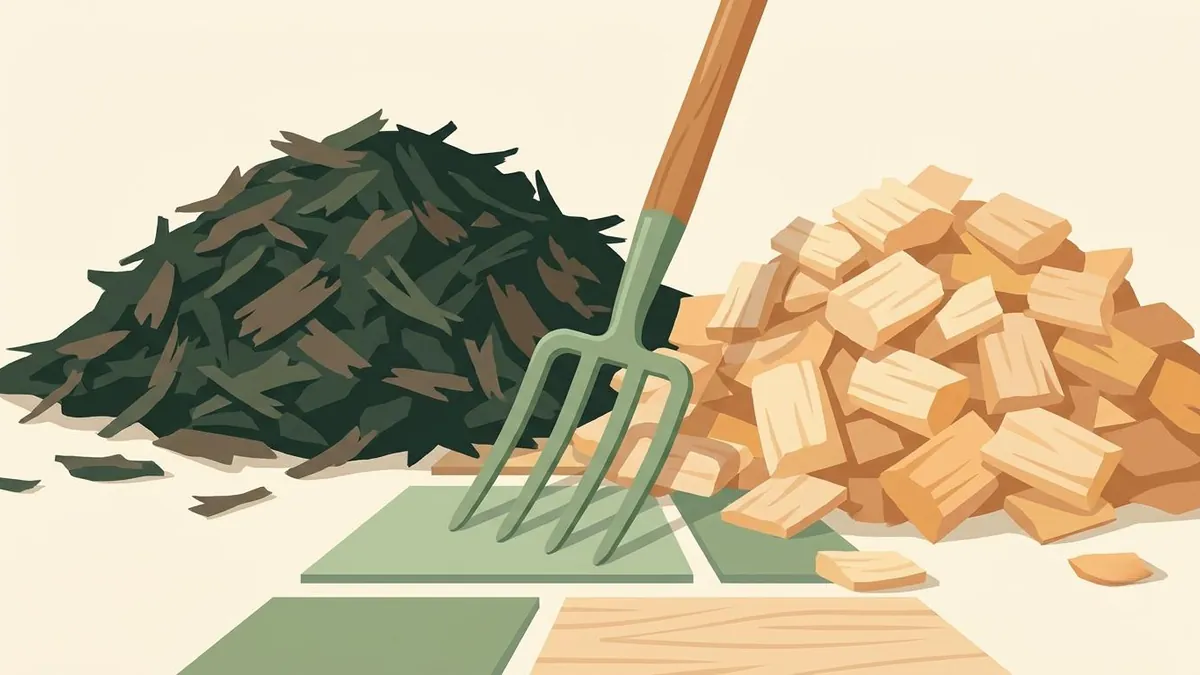
| Made from | The outer bark, shredded or in nuggets | Chipped branches and trunk wood, often with leaves |
| Look | Even colour and size | Mixed sizes and colours |
| Breaks down | Slowly; nuggets slowest | Faster |
| Cost | Higher | Lower; sometimes free from tree surgeons |
| Typical depth | 2–3 in (5–7.5 cm) | 3–4 in (7.5–10 cm) |
| Best for | Front beds, borders, around shrubs | Paths, under trees, large informal areas |
When bark is the better choice
- You want a tidy, uniform finish near the house.
- You want to top up less often.
- The bed is level. Bark nuggets are light and can float away on slopes in heavy rain; shredded bark knits together and stays put better.
When wood chips are the better choice
- You are covering a large area and cost matters.
- You are making a path or mulching under established trees and shrubs.
- You want to improve the soil over time. Chips break down faster and add organic matter.
Do fresh wood chips take nitrogen from the soil?
Only in the thin zone where chips touch the soil, and only while they decompose. Used as a surface layer around established plants, this has little effect on roots lower down. The problem comes when fresh chips are dug into the soil, or used around shallow-rooted seedlings and annual vegetables. For those, use compost or well-aged chips.
Dyed mulch
Red, black and brown dyed mulches are usually chipped wood with colour added. They hold their colour longer than natural bark but add little to the soil. Ask the supplier what wood is used.
How much to buy
Because chips go on deeper than bark, the same bed needs more of them. A 100 square foot bed takes about 0.6 cubic yards at 2 inches but 1.2 cubic yards at 4 inches. In metric, 10 m² takes 0.5 m³ at 5 cm and 1 m³ at 10 cm. Enter your own bed and depth in the mulch calculator to compare. For the reasoning behind each depth, see how deep mulch should be.
Skip the arithmetic. Enter your measurements and get quantities in imperial or metric units.
Open the Mulch CalculatorMonthly home energy tips
One email a month with our new guides, a free calculator to try and the latest electricity prices. Unsubscribe any time.
The signup form is provided by Hostinger Reach and loads when you click. You confirm by email before you get anything. Privacy policy.
Related guides
Garden & Outdoor
How Much Area Does a Bag of Mulch Cover?
A 2 cubic foot bag covers 12 square feet at 2 inches deep and 8 square feet at 3 inches. Coverage chart for common…
Garden & Outdoor
How to Calculate Cubic Yards (With Worked Examples)
Multiply length by width by depth in feet, then divide by 27. Worked examples for mulch, soil and gravel, plus a quick table and…
Garden & Outdoor
How Many Bags Are in a Cubic Yard? (Mulch, Soil, Gravel)
A cubic yard is 27 cubic feet, so it takes 36 bags of 0.75 cu ft, 27 of 1 cu ft, 18 of 1.5…