Tile Calculator
Count the tiles and boxes for a floor or wall, with a waste allowance for cuts and breakage.
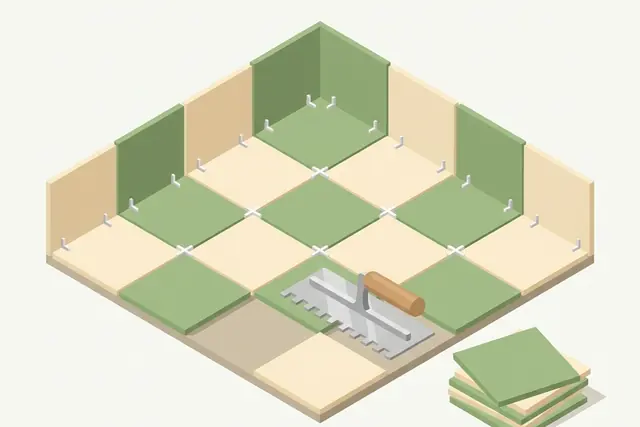
How the tile calculation works
- Area. Length × width of the floor or wall.
- Waste. Area × 1.10, 1.15 or 1.20, depending on the layout.
- Tiles. Divide by the area of one tile and round up.
- Boxes. Divide the tiles by the number in a box and round up.
tiles = (area sq ft × (1 + waste)) ÷ (tile length in × tile width in ÷ 144)
tiles = (area m² × (1 + waste)) ÷ (tile length mm × tile width mm ÷ 1,000,000)
Example: a 10 ft × 8 ft floor is 80 sq ft. With 10% waste that is 88 sq ft. A 12 in × 12 in tile covers 1 sq ft, so buy 88 tiles, or 9 boxes of 10.
Example: a 3 m × 2.4 m floor is 7.2 m². With 10% waste that is 7.92 m². A 300 mm × 300 mm tile covers 0.09 m², so buy 88 tiles, or 9 boxes of 10.
Waste allowance by layout
| Layout or room | Add | Why |
|---|---|---|
| Straight grid, simple rectangle | 10% | Cuts only at the edges. |
| Brick or offset pattern | 10–15% | More cut pieces at each row end. |
| Diagonal or herringbone | 15% | Every edge tile is cut at an angle. |
| Many corners, niches or large tiles | 15–20% | More offcuts that cannot be reused. |
Tiles per square foot and square metre
| Tile size | Area per tile | Tiles per 100 sq ft |
|---|---|---|
| 4 × 4 in | 0.11 sq ft | 900 |
| 6 × 6 in | 0.25 sq ft | 400 |
| 12 × 12 in | 1 sq ft | 100 |
| 12 × 24 in | 2 sq ft | 50 |
| 24 × 24 in | 4 sq ft | 25 |
| Tile size | Area per tile | Tiles per 10 m² |
|---|---|---|
| 100 × 100 mm | 0.01 m² | 1,000 |
| 150 × 150 mm | 0.0225 m² | 445 |
| 300 × 300 mm | 0.09 m² | 112 |
| 300 × 600 mm | 0.18 m² | 56 |
| 600 × 600 mm | 0.36 m² | 28 |
Counts are before waste and rounded up.
Before you buy
- For an L-shaped room, split it into rectangles, add the areas, and use “I know the area”.
- For walls, subtract large openings such as a door or a window. Do not subtract small ones.
- Use the actual tile size from the box. A “12 inch” or “300 mm” tile is often a few millimetres smaller.
- Adhesive and grout quantities depend on tile size and joint width. Follow the coverage figures on those products.
Common questions
How much extra tile should I buy?
Add 10 percent for a straight grid layout in a simple room. Add 15 percent for diagonal or herringbone layouts, and for rooms with many corners, because more tiles are cut. Add up to 20 percent for large-format tile in a small or awkward room.
How do I work out how many tiles I need?
Divide the area to be tiled by the area of one tile, add your waste allowance, and round up. For a 10 ft by 8 ft floor with 12 inch tiles: 80 square feet divided by 1 square foot is 80 tiles, plus 10 percent is 88.
Does the grout line change the number of tiles?
Only slightly. Grout joints add a little to each tile, so ignoring them gives a small safety margin. This calculator ignores the joint.
Why should I keep spare tiles?
Tile colour and size vary between production batches. A few spare tiles from the same batch let you repair a cracked tile later without a visible mismatch.
Should I buy all the tile at once?
Yes. Check that every box has the same batch or lot number and shade code before you start. Mixing batches can show as a visible change across the floor.
Monthly home energy tips
One email a month with our new guides, a free calculator to try and the latest electricity prices. Unsubscribe any time.
The signup form is provided by Hostinger Reach and loads when you click. You confirm by email before you get anything. Privacy policy.