What Is a C-Wire, and Do You Need One for a Smart Thermostat?
The C (common) wire gives a thermostat steady 24-volt power. Many smart thermostats need one. How to check for it and the options if you do not have one.
Skip the arithmetic. Enter your own appliances, usage and prices and the calculator does the sums.
Open the Energy Savings CalculatorMost central heating and cooling systems in North America control the thermostat with low-voltage wiring, usually 24 volts. The C-wire (“common”) completes that circuit so the thermostat has a steady supply of power. A basic thermostat can run on batteries, but a smart thermostat with Wi-Fi and a screen needs more, so many models require a C-wire.
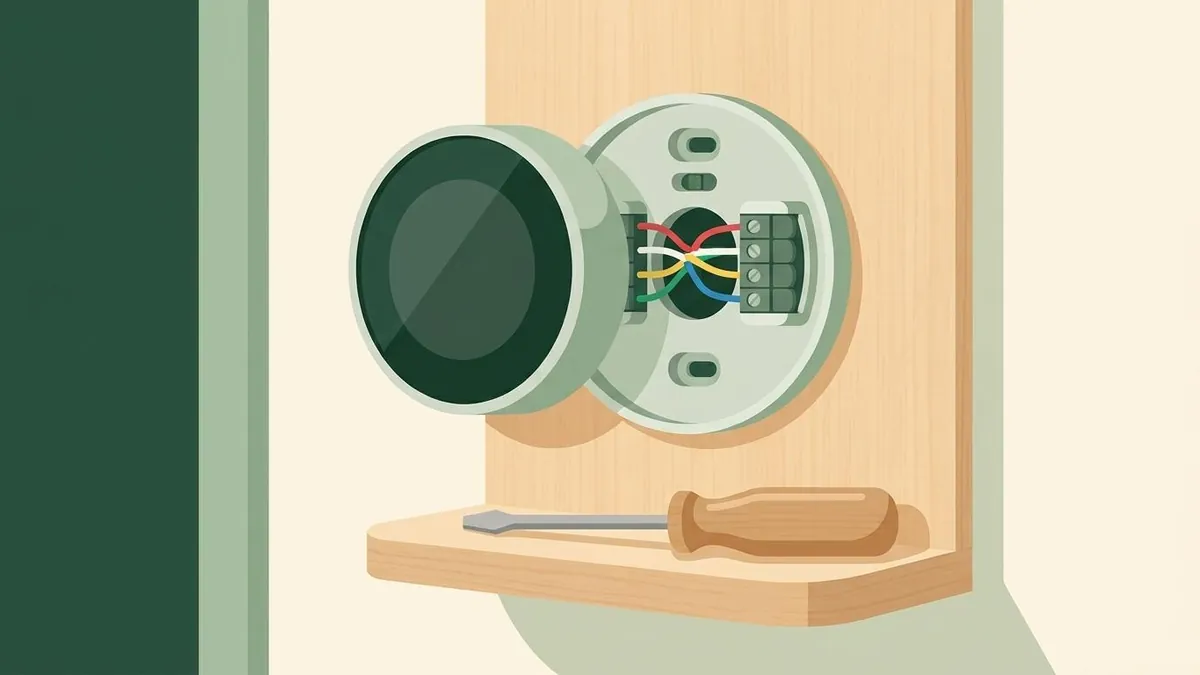
Common thermostat wires
| Terminal | Usual job |
|---|---|
| R (Rh, Rc) | 24-volt power from the system |
| C | Common: completes the circuit for steady power |
| W | Heating |
| Y | Cooling |
| G | Fan |
| O/B | Heat pump reversing valve |
Installers do not always follow the usual wire colours, so go by the letter on the terminal each wire connects to.
Check whether you have one
- Turn off power to the heating and cooling system at its switch or breaker.
- Remove the thermostat from its wall plate.
- Take a clear photo of the wiring before you touch anything.
- Look for a wire on the C terminal. Also look for an unused wire folded back into the wall, which may already be connected at the furnace or air handler end.
Stop if it is a line-voltage thermostat
If the thermostat controls electric baseboard heaters and has thick wires, often marked 120 or 240 volts, it is a line-voltage thermostat. Most smart thermostats made for central systems cannot be used with it, and the wiring carries dangerous voltage. Use a thermostat made for line voltage, and an electrician if you are unsure.
Options if there is no C-wire
- If the cable has an unused wire, it can often be connected to C at both ends.
- Some thermostat makers include or sell a power adapter or extender kit that fits at the furnace or air handler and frees up a wire for C.
- A 24-volt plug-in transformer made for thermostats can be wired to the C and R terminals as its instructions describe.
- An installer can run new thermostat cable with enough conductors.
- Some models work without a C-wire by drawing small amounts of power through the other wires. On some systems that causes problems, so check the maker’s compatibility checker for your equipment first.
Before you buy
Most smart thermostat makers have an online compatibility checker. Enter the letters from your photo, your system type (gas furnace, heat pump, boiler, multi-stage) and whether you have a C-wire. If your system is unusual, or you are not comfortable working at the furnace, a heating and cooling technician can fit it.
Is it worth it?
A smart thermostat saves money only by running heating and cooling less when nobody needs it. Do smart thermostats save energy? covers how much, and smart vs programmable thermostats compares the two. The energy savings calculator shows the payback time.
Sources
- ENERGY STAR (US EPA): Smart Thermostats
- US Department of Energy: Home Upgrades (thermostat settings)
Skip the arithmetic. Enter your own appliances, usage and prices and the calculator does the sums.
Open the Energy Savings CalculatorMonthly home energy tips
One email a month with our new guides, a free calculator to try and the latest electricity prices. Unsubscribe any time.
The signup form is provided by Hostinger Reach and loads when you click. You confirm by email before you get anything. Privacy policy.
Related guides
Smart Home
How Much Electricity Does a Wi-Fi Router Use?
A router drawing 10 W all day uses about 88 kWh a year, about $15 at $0.17 per kWh. Why the adapter rating overstates…
Smart Home
Smart Switch vs Smart Bulb: Which Should You Choose?
A smart switch controls every bulb on a circuit and keeps the wall switch working; smart bulbs add colour and need no wiring. How…
Smart Home
Do Smart Plugs Save Energy?
A smart plug saves energy only when it switches off something that would otherwise stay on. The plug itself uses a little power, so…