Do You Need Primer Before Painting?
Prime new drywall, bare plaster, bare wood, stains and big colour changes. Skip primer on clean, sound, previously painted walls. A quick guide to deciding.
Skip the arithmetic. Enter your measurements and get quantities in imperial or metric units.
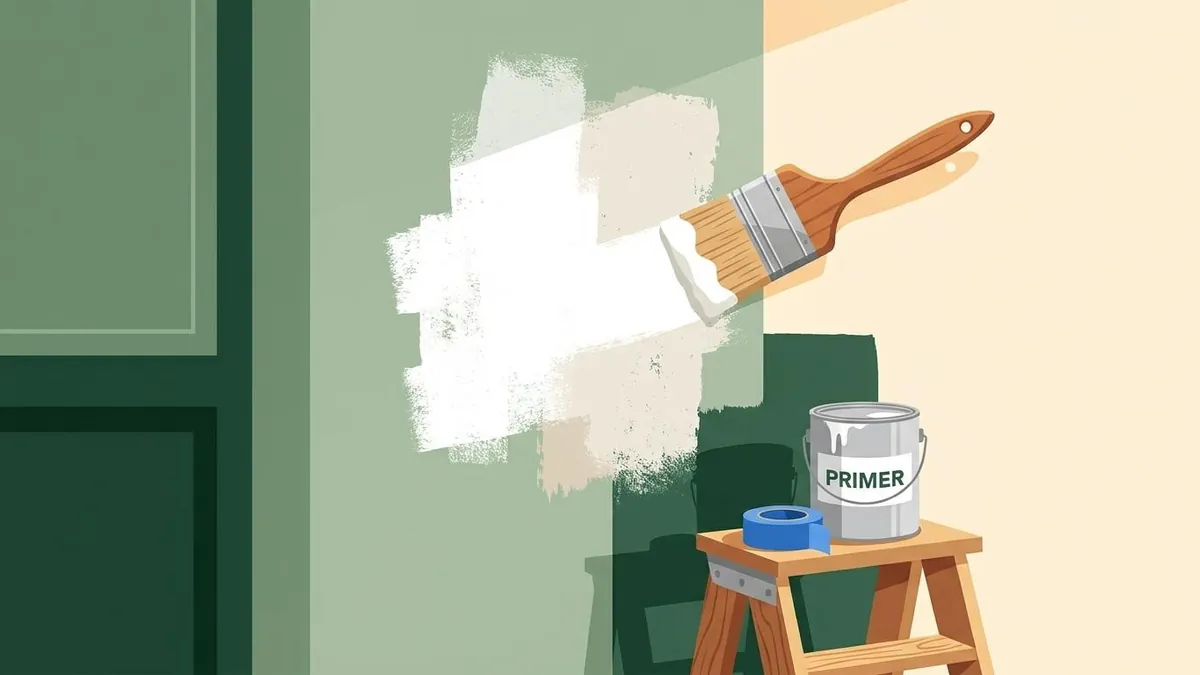
Open the Paint CalculatorYou need primer when the surface is bare, stained, glossy, or a very different colour from the new paint. You can usually skip it when repainting a clean, sound wall in a similar colour.
Quick decision table
| Surface | Primer? | Why |
|---|---|---|
| New drywall or bare plaster | Yes | It absorbs paint unevenly and leaves dull patches. |
| Bare wood | Yes | Seals the grain and stops knots bleeding through. |
| Patched or filled areas | Spot prime | Filler is more porous than the wall around it. |
| Water, smoke or marker stains | Yes, stain-blocking | Stains bleed through ordinary paint. |
| Dark colour going light | Yes | Cheaper than extra coats of finish paint. |
| Gloss or oil-based paint | Yes, after sanding | New paint does not grip a shiny surface. |
| Sound painted wall, similar colour | No | The old paint already seals the surface. |
What primer does
- Seals porous surfaces so the finish coat dries evenly.
- Bonds to slick surfaces and gives the finish coat something to hold.
- Blocks stains, tannins and old colours from showing through.
New plaster: the mist coat
In the UK and Ireland, fresh plaster is usually sealed with a mist coat: matt emulsion thinned with water as the paint maker directs. It does the job of a primer on that surface. Let new plaster dry fully first; it turns from dark to an even pale pink.
What about paint-and-primer-in-one?
These are thicker finish paints. They work well for repainting sound walls and for modest colour changes. They are not a substitute for a real primer on bare drywall, bare wood or stains.
Which type of primer
- Water-based (latex or acrylic): new drywall, general use, low odour.
- Oil-based: bare wood, and covering old oil-based paint.
- Shellac-based: heavy stains, smoke damage and knots.
Read the can for the surfaces it suits and for ventilation advice.
How much primer
Primer covers less area than finish paint, typically 200 to 300 sq ft per US gallon, or 5 to 7 m² per litre, because bare surfaces absorb it. One coat is normally enough. Tick the primer box in the paint calculator to add it to your room. For the paint itself, see how much paint a room needs.
Skip the arithmetic. Enter your measurements and get quantities in imperial or metric units.
Open the Paint CalculatorMonthly home energy tips
One email a month with our new guides, a free calculator to try and the latest electricity prices. Unsubscribe any time.
The signup form is provided by Hostinger Reach and loads when you click. You confirm by email before you get anything. Privacy policy.
Related guides
Home Improvement
How to Calculate Square Footage of a Room or Yard
Length times width for a rectangle. For an L-shaped room, split it into rectangles. Formulas for triangles and circles, plus square feet to square…
Home Improvement
How Much Paint Do You Need for a Room?
An average bedroom needs about 2 gallons (5 to 6 litres) for two coats on the walls. See a chart by room size and…
Home Improvement
How Much Extra Tile Should You Buy?
Buy 10 percent extra tile for a straight layout and 15 percent for diagonal or herringbone. See why, when to go to 20 percent,…