Pea Gravel vs Crushed Stone: Which One for Your Project?
Pea gravel is round, smooth and comfortable; crushed stone is angular and locks together. See which suits paths, patios, drainage and driveways.
Skip the arithmetic. Enter your measurements and get quantities in imperial or metric units.
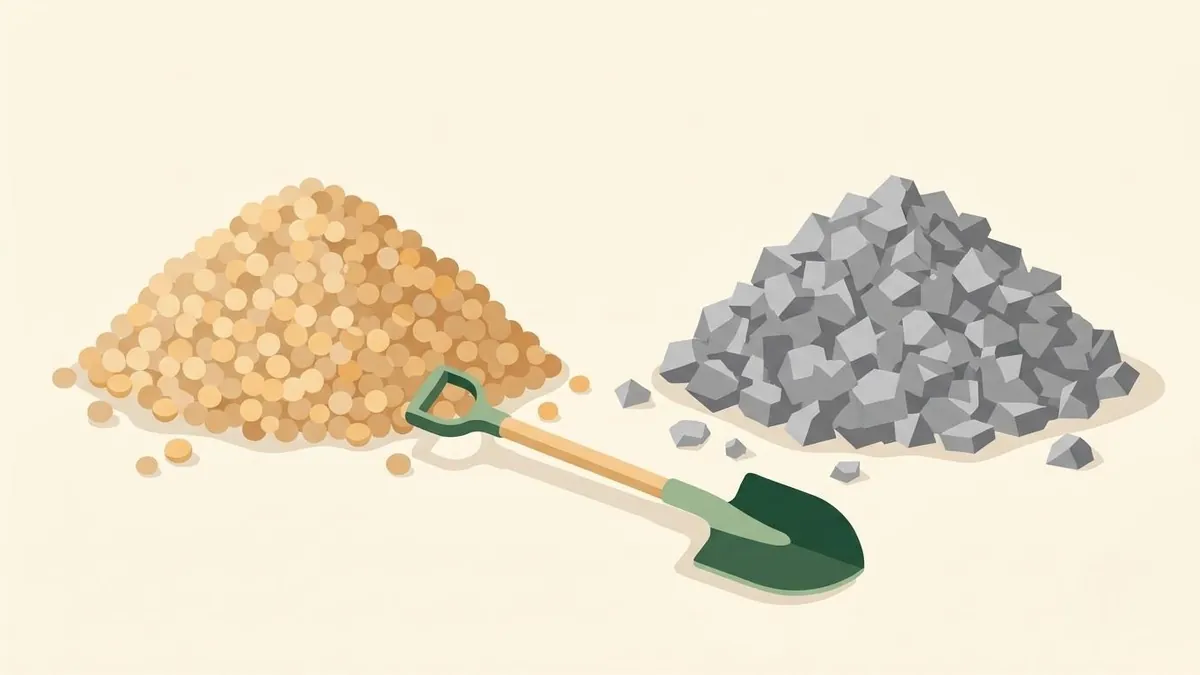
Open the Gravel CalculatorThe choice comes down to shape. Pea gravel is small and rounded, so it stays loose. Crushed stone has sharp, broken faces, so the pieces lock together when pressed.
Side by side
| Pea gravel | Crushed stone | |
|---|---|---|
| Shape | Rounded, smooth | Angular, rough |
| Typical size | About 3/8 in (10 mm) | From dust up to 2 in (50 mm), sold in grades |
| Underfoot | Comfortable, shifts when walked on | Firm once compacted |
| Compacts | No | Yes, especially grades that include fines |
| Needs edging | Always | Recommended |
| Best for | Garden paths, play areas, decorative beds, drainage around pipes | Driveways, bases under paving and sheds, firm paths |
Where pea gravel works
- Low-traffic garden paths and seating areas, at about 2 inches (5 cm) deep.
- Decorative cover over landscape fabric.
- Around drains, where water must pass through freely.
It is a poor choice for slopes and driveways. Round stones roll under tyres and feet, form ruts, and migrate downhill.
Where crushed stone works
- Driveways and parking areas.
- The compacted base under pavers, slabs, sheds and decks.
- Paths that need to take a wheelbarrow or wheelchair.
For a base layer, ask for a graded mix that includes fine particles. In the US this is often sold as crusher run or dense grade aggregate; in the UK the usual product is MOT Type 1. The fines fill the gaps so the layer compacts hard.
Using both
A common build for a firm path is 3 to 4 inches (7.5 to 10 cm) of compacted crushed stone with a thin layer of decorative gravel on top. The base carries the load and the top layer gives the look.
Cost and quantity
Both are sold by volume or by weight, and their densities are close: roughly 1.5 to 1.6 tonnes per cubic metre, or about 1.3 US tons per cubic yard. Price depends far more on local quarries and delivery distance than on the type. Enter your area and depth in the gravel calculator to get volume, weight and bag counts for either. For a full driveway build-up, see how much gravel a driveway needs.
Skip the arithmetic. Enter your measurements and get quantities in imperial or metric units.
Open the Gravel CalculatorMonthly home energy tips
One email a month with our new guides, a free calculator to try and the latest electricity prices. Unsubscribe any time.
The signup form is provided by Hostinger Reach and loads when you click. You confirm by email before you get anything. Privacy policy.
Related guides
Garden & Outdoor
How Much Area Does a Bag of Mulch Cover?
A 2 cubic foot bag covers 12 square feet at 2 inches deep and 8 square feet at 3 inches. Coverage chart for common…
Garden & Outdoor
How to Calculate Cubic Yards (With Worked Examples)
Multiply length by width by depth in feet, then divide by 27. Worked examples for mulch, soil and gravel, plus a quick table and…
Garden & Outdoor
How Many Bags Are in a Cubic Yard? (Mulch, Soil, Gravel)
A cubic yard is 27 cubic feet, so it takes 36 bags of 0.75 cu ft, 27 of 1 cu ft, 18 of 1.5…