How Long Will a Portable Power Station Run a Refrigerator?
Divide the usable watt-hours by the fridge's average watts. A 1,000 Wh power station runs a 400 kWh-a-year fridge for about 18 hours. Worked examples and tips.
Skip the arithmetic. Enter your own appliances, usage and prices and the calculator does the sums.
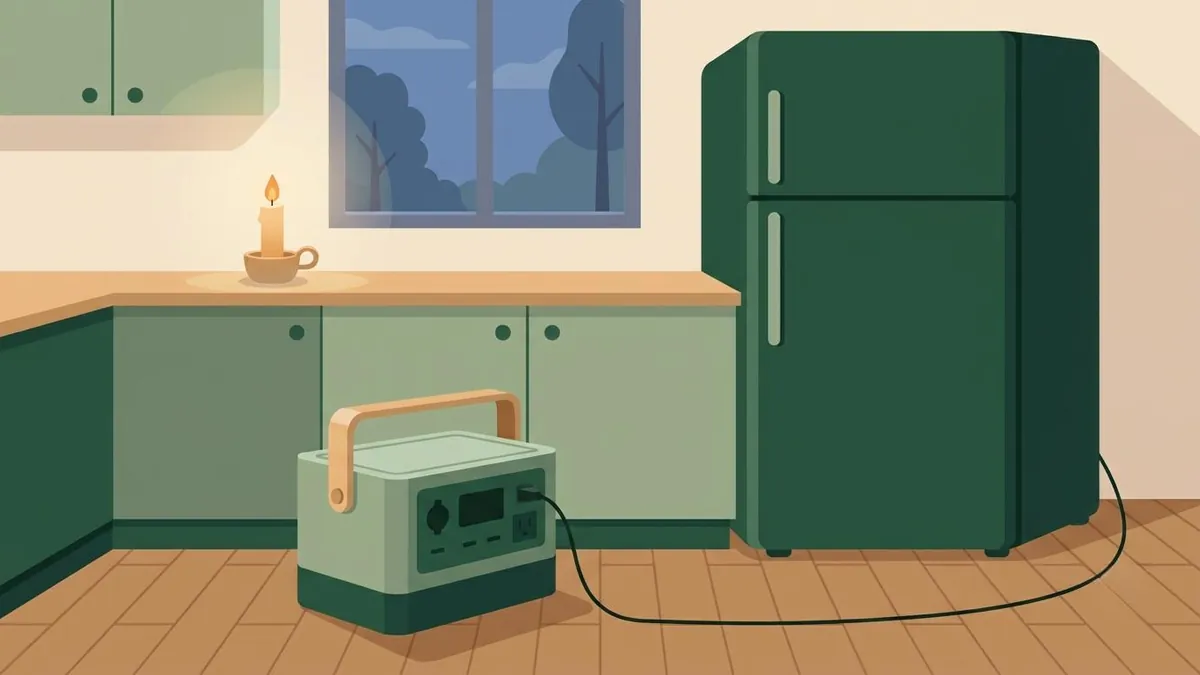
Open the Solar Generator CalculatorDivide the power station’s usable watt-hours by the fridge’s average watts. A 1,000 Wh power station can run a fridge labelled 400 kWh a year for about 18 hours, before allowing for door openings and a warm room.
The formula
hours = capacity in Wh × 0.85 ÷ average fridge watts
The 0.85 allows for the energy lost turning the battery’s stored power into household AC power. It is a planning figure; the unit’s manual may give its own.
Step 1: the fridge’s average watts
Take the yearly kWh from the fridge’s EnergyGuide label and turn it into average watts:
average watts = yearly kWh × 1,000 ÷ 8,760
For a 400 kWh fridge that is about 46 W, or about 1,096 Wh a day. If you have no label, measure the fridge with a plug-in energy monitor for a few days. How much electricity does a refrigerator use explains both methods.
Step 2: run time by capacity
For the 400 kWh fridge, about 46 W on average:
| Power station capacity | Usable at 85% | Approximate run time |
|---|---|---|
| 500 Wh | 425 Wh | about 9 hours |
| 1,000 Wh | 850 Wh | about 18 hours |
| 2,000 Wh | 1,700 Wh | about 37 hours |
The 1,000 Wh row: 1,000 × 0.85 = 850 Wh, and 850 ÷ 46 = about 18 hours.
Why real run time is often shorter
- Opening the door lets warm air in, and the compressor runs more.
- A warm room or a hot day makes the fridge work harder.
- Labels are measured in set test conditions, not your kitchen.
Plan for less than the table shows, or measure your fridge on the power station once before you rely on it.
Check the output rating too
Capacity decides how long the fridge runs. The power station’s output rating decides whether it can start the fridge at all. A compressor draws a short surge when it starts, often around three times its running power. Check that the unit’s continuous output covers the fridge’s running watts, and its surge or peak rating covers the start-up.
Food safety in a power cut
US food safety guidance says a closed refrigerator keeps food safe for about 4 hours without power. A full freezer holds its temperature for about 48 hours, or about 24 hours if half full, as long as the door stays closed. Keep the doors shut, and use a fridge thermometer to check the temperature stays at 40°F or below.
Make the battery last longer
- Keep the doors closed and the fridge full. Bottles of water help fill empty space.
- Turn off other devices on the power station that you do not need.
- Recharge from solar panels in the daytime, if the unit supports it.
Safety
Plug the fridge into the power station’s own socket. Never connect a power station or generator to your home’s wiring through a wall socket. Connecting to household circuits needs a transfer switch or an approved system installed by a qualified electrician.
Size a power station for everything
To plan for the fridge plus lights, phones and a router, list them all in the solar generator calculator. What size solar generator do I need walks through a full example.
Sources
- FoodSafety.gov: Food Safety During a Power Outage
- Sandia National Laboratories for the US Department of Energy: refrigeration units in off-grid systems (start-up current)
Skip the arithmetic. Enter your own appliances, usage and prices and the calculator does the sums.
Open the Solar Generator CalculatorMonthly home energy tips
One email a month with our new guides, a free calculator to try and the latest electricity prices. Unsubscribe any time.
The signup form is provided by Hostinger Reach and loads when you click. You confirm by email before you get anything. Privacy policy.
Related guides
Energy & Solar
What Is Phantom Power, and How Much Does It Cost?
Phantom power is electricity devices use while switched off or on standby. The US DOE puts it at almost 10 percent of home electricity…
Energy & Solar
LED vs Incandescent Bulbs: How Much Do You Save?
A 9-watt LED gives about the same light as a 60-watt incandescent. Used 3 hours a day, the LED saves about 56 kWh a…
Energy & Solar
Electricity Cost by State in 2026: What Appliances Cost to Run
US homes paid 18.19 cents per kWh on average from January to August 2026, from 12.46 cents in North Dakota to 46.41 cents in…