LED vs Incandescent Bulbs: How Much Do You Save?
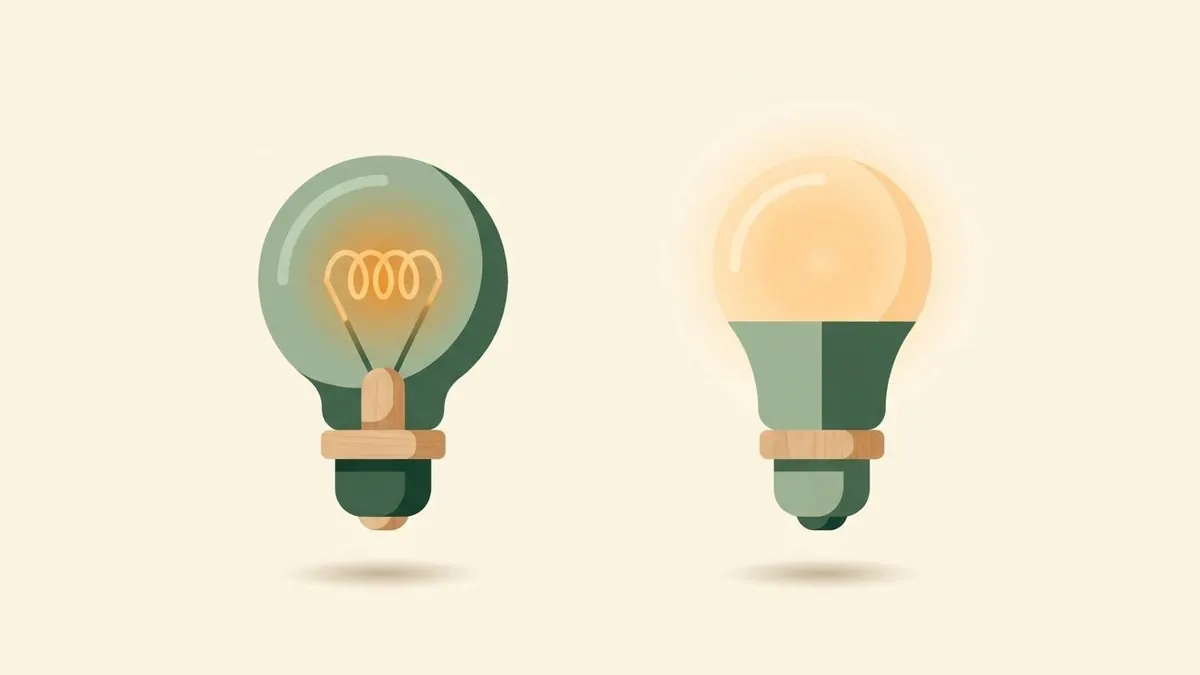
A 9-watt LED gives about the same light as a 60-watt incandescent. Used 3 hours a day, the LED saves about 56 kWh a year, or about $9.49 at $0.17 per kWh.
Skip the arithmetic. Enter your own appliances, usage and prices and the calculator does the sums.
Open the Energy Savings CalculatorThe US Department of Energy says residential LEDs use at least 75 percent less energy than incandescent bulbs and last about 25 times longer. Swapping one 60-watt incandescent for a 9-watt LED that is used 3 hours a day saves about 56 kWh a year, or about $9.49 at an example price of $0.17 per kWh.
In the UK, the Ofgem price cap for October to December 2026 is 26.32p per kWh, so the 56 kWh saved is worth about £14.70 a year.
Match the light, not the watts
Brightness is measured in lumens. Watts only tell you how much power a bulb uses. Use this guide to replace an old bulb with an LED that gives the same light:
| Old incandescent | Light output |
|---|---|
| 40 W | about 450 lumens |
| 60 W | about 800 lumens |
| 75 W | about 1,100 lumens |
| 100 W | about 1,600 lumens |
An 800-lumen LED usually uses around 8 to 10 watts. The exact figure is on the box.
The saving for one bulb
Example: a 60 W incandescent and a 9 W LED, each used 3 hours a day.
| Per bulb | Incandescent 60 W | LED 9 W |
|---|---|---|
| Energy a year | 65.7 kWh | 9.9 kWh |
| Cost a year at $0.17 | $11.17 | $1.68 |
The incandescent: 60 × 3 × 365 ÷ 1,000 = 65.7 kWh. The LED: 9 × 3 × 365 ÷ 1,000 = 9.855 kWh. The difference is about 55.8 kWh, and 55.8 × $0.17 = about $9.49 a year for that one bulb.
Ten bulbs used the same way would save about $94.90 a year. Bulbs you rarely switch on save much less, so start with the lights that are on the longest.
Lasting longer
Because an LED lasts many times longer, you also buy far fewer bulbs over the years. That matters most for fittings that are hard to reach, such as high ceilings and outside lights.
Choosing an LED
- Colour. Measured in kelvin (K). Around 2,700 K is a warm white like an old incandescent; higher numbers look cooler and bluer.
- Dimmers. Not every LED works on a dimmer. Choose one marked dimmable, and check it suits your dimmer switch.
- Enclosed fittings. Some LEDs are not rated for fully enclosed fixtures, where heat builds up. Check the packaging.
- ENERGY STAR. Certified bulbs are tested for light output, colour and life.
Estimate your saving
Enter the energy you would save and your price in the energy savings calculator. Add the cost of the new bulbs to see how quickly they pay for themselves. To work out what any light costs to run, use the electricity cost calculator.
Sources
Skip the arithmetic. Enter your own appliances, usage and prices and the calculator does the sums.
Open the Energy Savings CalculatorMonthly home energy tips
One email a month with our new guides, a free calculator to try and the latest electricity prices. Unsubscribe any time.
The signup form is provided by Hostinger Reach and loads when you click. You confirm by email before you get anything. Privacy policy.
Related guides
Energy & Solar
What Is Phantom Power, and How Much Does It Cost?
Phantom power is electricity devices use while switched off or on standby. The US DOE puts it at almost 10 percent of home electricity…
Energy & Solar
How Long Will a Portable Power Station Run a Refrigerator?
Divide the usable watt-hours by the fridge's average watts. A 1,000 Wh power station runs a 400 kWh-a-year fridge for about 18 hours. Worked…
Energy & Solar
Electricity Cost by State in 2026: What Appliances Cost to Run
US homes paid 18.19 cents per kWh on average from January to August 2026, from 12.46 cents in North Dakota to 46.41 cents in…