How Thick Should a Concrete Slab Be?
Patios and paths are usually 4 inches (100 mm) thick; driveways 5 to 6 inches (125 to 150 mm). See typical thicknesses, base depth and control joint spacing.
Skip the arithmetic. Enter your measurements and get quantities in imperial or metric units.
Open the Concrete Bag CalculatorFour inches (100 mm) is the standard thickness for patios, paths and shed bases. Driveways that carry cars are usually 5 to 6 inches (125 to 150 mm).
Typical thickness by use
| Use | Thickness (in) | Thickness (mm) |
|---|---|---|
| Garden path, patio | 4 | 100 |
| Shed base, hot tub pad | 4–6 | 100–150 |
| Driveway for cars | 5–6 | 125–150 |
| Driveway for heavy vehicles | 6 or more | 150 or more |
These are common figures, not a structural design. Garages, anything that supports a building, and slabs on poor ground need sizing to your local building code.
Why thickness matters so much
A slab’s strength rises steeply with thickness. Going from 4 to 5 inches uses 25 percent more concrete but gives a much stiffer slab. It is the cheapest strength you can buy, and it cannot be added later.
The base under the slab
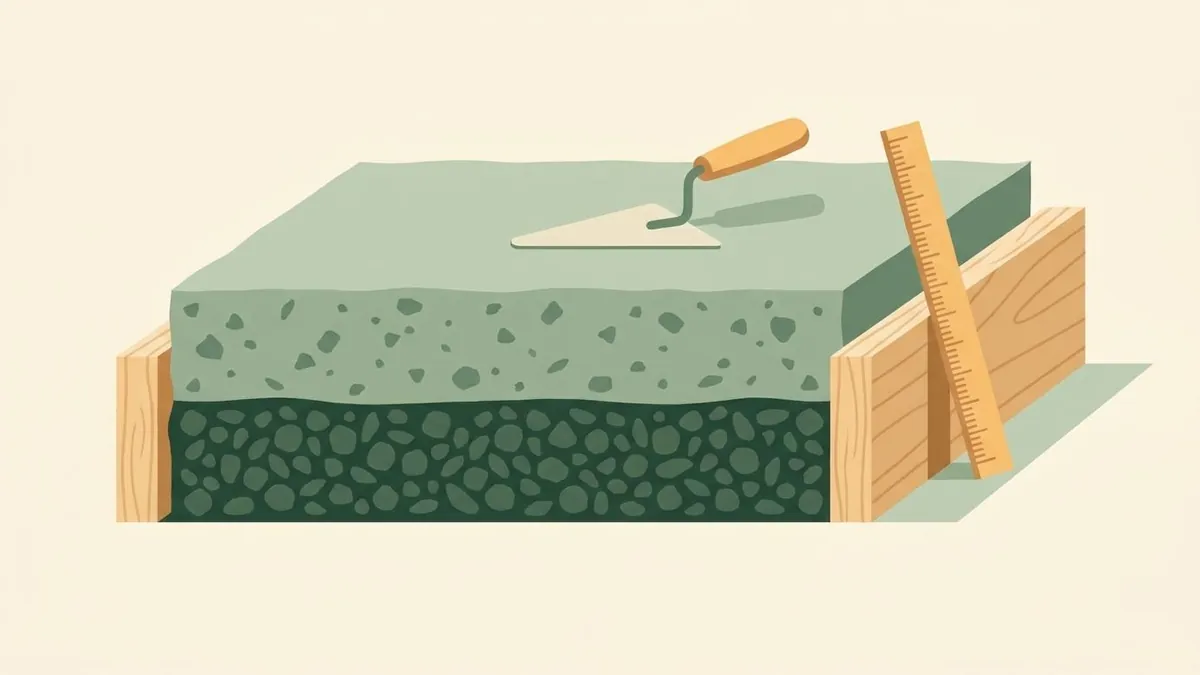
Concrete cracks when the ground under it moves. Lay the slab on about 4 inches (100 mm) of compacted crushed stone over firm, undisturbed soil. Remove topsoil first: it holds water and compresses.
Reinforcement
Steel mesh or rebar does not stop cracks from forming. It holds the slab together when they do, so cracks stay tight and level. For a driveway or a slab on doubtful ground, it is worth including. Set it in the middle to upper part of the slab, not on the ground.
Control joints
Concrete shrinks as it cures, and it will crack. Control joints decide where. A widely used rule is to space joints, in feet, at 2 to 3 times the slab thickness in inches. A 4 inch slab gets joints every 8 to 12 feet (about 2.5 to 3.5 m). Cut or tool them to a quarter of the slab depth.
How thickness changes the order
| Thickness | Volume (imperial) | 80 lb bags | Volume (metric, 3 × 3 m) | 20 kg bags |
|---|---|---|---|---|
| 4 in / 100 mm | 1.23 cu yd | 56 | 0.90 m³ | 98 |
| 5 in / 125 mm | 1.54 cu yd | 70 | 1.13 m³ | 122 |
| 6 in / 150 mm | 1.85 cu yd | 84 | 1.35 m³ | 146 |
At these volumes, hand-mixing bags is slow and it is hard to finish the slab in one pour. Above about one cubic yard or one cubic metre, get a ready-mix quote.
Work out your slab
Enter your length, width and thickness in the concrete calculator to get the volume and the bag count for each bag size, with a waste allowance.
Skip the arithmetic. Enter your measurements and get quantities in imperial or metric units.
Open the Concrete Bag CalculatorMonthly home energy tips
One email a month with our new guides, a free calculator to try and the latest electricity prices. Unsubscribe any time.
The signup form is provided by Hostinger Reach and loads when you click. You confirm by email before you get anything. Privacy policy.
Related guides
Home Improvement
How Many Bags of Concrete for a Fence Post?
A 4x4 post in a 10 inch hole 24 inches deep takes about 0.9 cubic feet of concrete: two 80 lb bags or three…
Home Improvement
How Much Gravel Do You Need for a Driveway?
A gravel driveway needs 4 to 6 inches of compacted base plus 2 to 3 inches of surface stone. See worked examples in tons…
Home Improvement
How Deep Should Fence Posts Be?
Bury one third to one half of the fence height: 2 to 3 feet (60 to 90 cm) for a 6 foot fence. Includes…