How to Calculate How Much Electricity an Appliance Uses
Multiply watts by hours of use and divide by 1,000 to get kilowatt-hours, then multiply by your price per kWh. Worked examples for a heater, a TV and a fridge.
Skip the arithmetic. Enter your own appliances, usage and prices and the calculator does the sums.
Open the Electricity Cost CalculatorAn appliance’s energy use in kilowatt-hours (kWh) is its power in watts multiplied by the hours it runs, divided by 1,000. Multiply the kWh by the price on your bill and you have the cost.
In the UK, use your unit rate in pence per kWh instead. The Ofgem price cap for October to December 2026 is 26.32p per kWh.
The formula
kWh = watts × hours ÷ 1,000
cost = kWh × price per kWh
The watts are usually printed on a label on the back or base of the appliance, or on its charger. If the label gives only volts and amps, multiply them: 120 V × 2 A = 240 W.
Worked examples
These use an example price of $0.17 per kWh. Use the rate on your own bill.
| Appliance | Use | Energy per month | Cost per month |
|---|---|---|---|
| Space heater, 1,500 W | 4 hours a day | 180 kWh | $30.60 |
| TV, 100 W | 5 hours a day | 15 kWh | $2.55 |
| Laptop, 60 W | 4 hours a day | 7.2 kWh | $1.22 |
The heater: 1,500 × 4 ÷ 1,000 = 6 kWh a day. Over 30 days that is 180 kWh, and 180 × $0.17 = $30.60.
Appliances that cycle on and off
A fridge, freezer or air conditioner does not draw its full power all day, because the compressor switches on and off. For these, the yearly figure on an energy label is more useful than the watts. In the US, the yellow EnergyGuide label shows an estimated yearly energy use in kWh. Divide it by 12 for a monthly figure. A fridge labelled 400 kWh a year uses about 33 kWh a month, which is about $5.67 a month at $0.17 per kWh.
Why your measured figure may be lower
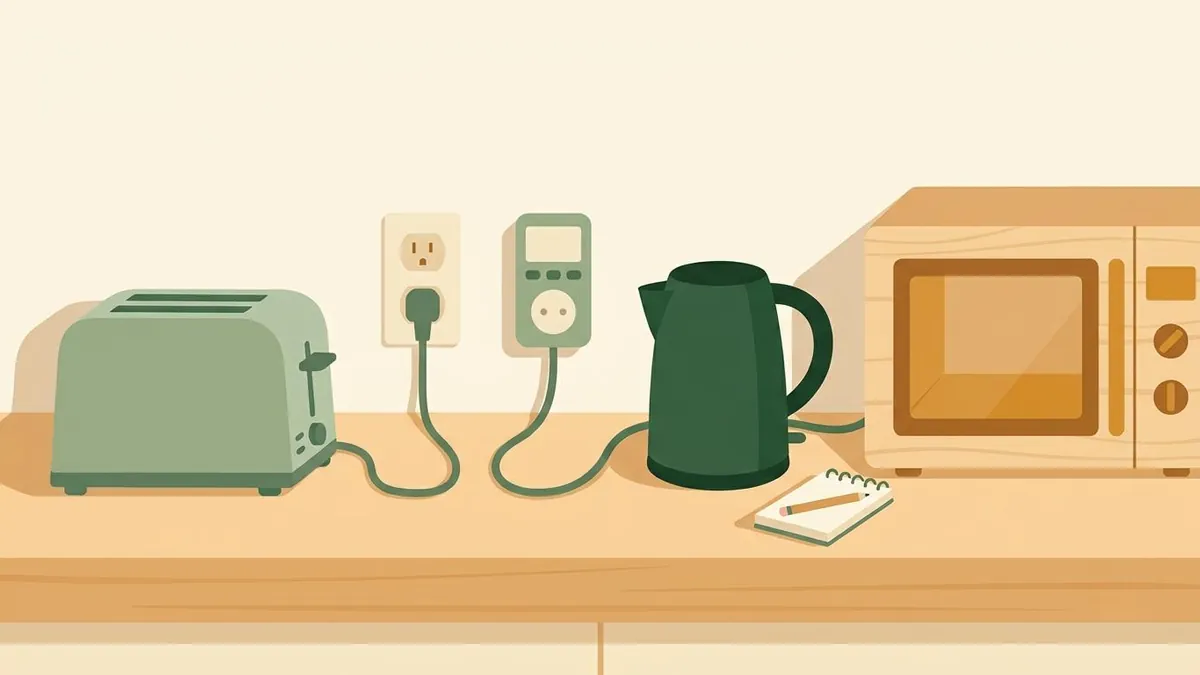
The watts on a label are usually the most the appliance can draw, not what it uses all the time. A plug-in energy monitor, placed between the socket and the appliance, shows the real draw and the kWh used over a few days. That is the most accurate way to check a single device.
Standby power
Many devices draw a little power even when they look switched off, for clocks, remote control sensors and network connections. It is small for each device, but it adds up across a house over a year. An energy monitor shows it, and a switched power strip cuts it.
Work it out for your home
The electricity cost calculator takes either your monthly kWh from a bill or one appliance’s watts and hours, and gives the daily, monthly and yearly cost. To estimate what a change could save, use the energy savings calculator.
Skip the arithmetic. Enter your own appliances, usage and prices and the calculator does the sums.
Open the Electricity Cost CalculatorMonthly home energy tips
One email a month with our new guides, a free calculator to try and the latest electricity prices. Unsubscribe any time.
The signup form is provided by Hostinger Reach and loads when you click. You confirm by email before you get anything. Privacy policy.
Related guides
Energy & Solar
What Is Phantom Power, and How Much Does It Cost?
Phantom power is electricity devices use while switched off or on standby. The US DOE puts it at almost 10 percent of home electricity…
Energy & Solar
How Long Will a Portable Power Station Run a Refrigerator?
Divide the usable watt-hours by the fridge's average watts. A 1,000 Wh power station runs a 400 kWh-a-year fridge for about 18 hours. Worked…
Energy & Solar
LED vs Incandescent Bulbs: How Much Do You Save?
A 9-watt LED gives about the same light as a 60-watt incandescent. Used 3 hours a day, the LED saves about 56 kWh a…