kW vs kWh: What Is the Difference?
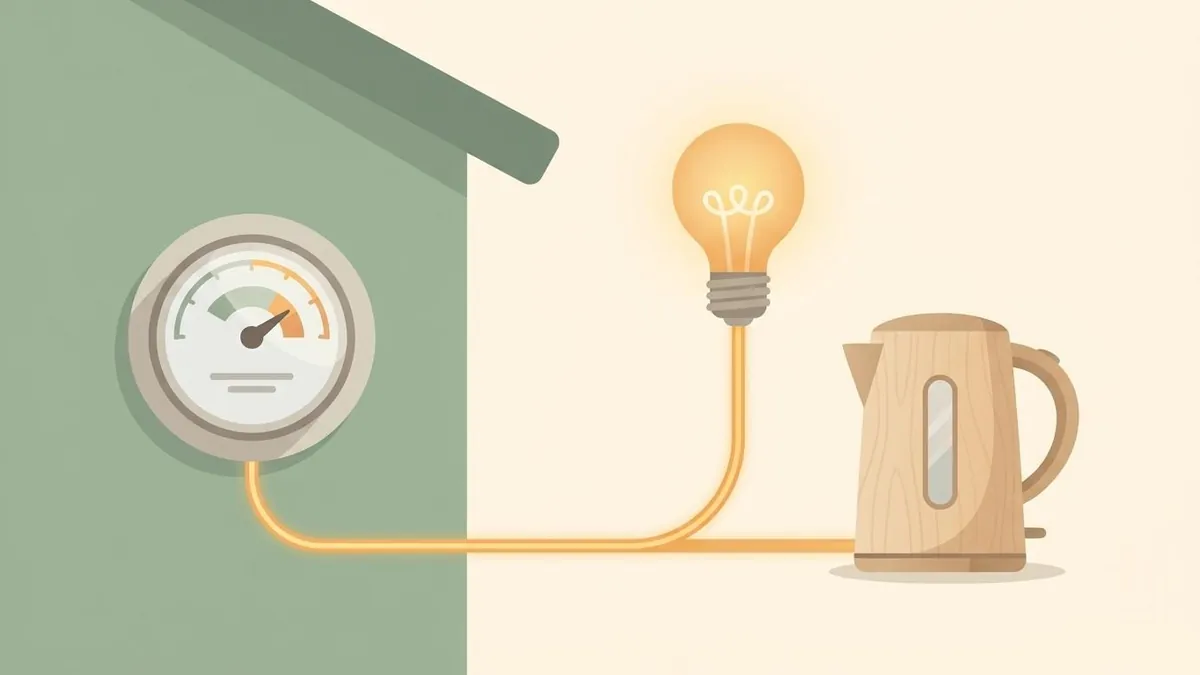
A kilowatt (kW) is how fast electricity is used; a kilowatt-hour (kWh) is how much is used. 1,000 watts for 1 hour is 1 kWh, and your bill charges per kWh.
Skip the arithmetic. Enter your own appliances, usage and prices and the calculator does the sums.
Open the Electricity Cost CalculatorA kilowatt (kW) measures power, meaning how fast something uses electricity at a given moment. A kilowatt-hour (kWh) measures energy, meaning how much electricity is used over time. Your electric bill charges for kWh.
The relationship
kWh = kW × hours
One kilowatt is 1,000 watts. Something drawing 1,000 watts for 1 hour uses 1 kWh, and so does something drawing 100 watts for 10 hours.
Everyday examples at $0.17 per kWh
| Device and time | Power | Energy | Cost |
|---|---|---|---|
| Space heater on high for 2 hours | 1.5 kW | 3 kWh | $0.51 |
| 10 W LED bulb for 100 hours | 0.01 kW | 1 kWh | $0.17 |
| Window air conditioner for 8 hours | 1 kW | 8 kWh | $1.36 |
If it helps, think of kW as a car’s speed and kWh as the distance it travels.
Watts, volts and amps
For simple loads such as heaters, watts are roughly volts × amps. A heater on a US 120-volt outlet drawing 12.5 amps uses about 1,500 W. On a 230-volt supply, as in the UK and most of Europe, the same 1,500 W draws about 6.5 amps. Appliance labels may give either amps or watts, and you can convert one into the other this way.
Where you see each unit
- Appliance labels give watts or kW, the rate while the appliance runs.
- Energy labels such as the US EnergyGuide give yearly kWh, the total over a year.
- Your bill charges a price per kWh, often plus a fixed daily or monthly charge. Some plans also charge for your highest kW demand in the month, so check yours.
- Batteries and power stations give capacity in Wh or kWh (energy) and output in W (power). A 1,000 Wh station stores 1 kWh, and its output rating limits what it can run at once.
- Solar panels are rated in watts (peak power), and what they produce over a day is measured in kWh.
Reading your own usage
Your bill shows the kWh used in the billing period. Divide by the number of days for a daily figure. Many utilities also show usage by day or by hour online, which helps you see what pushes your bill up.
Work it out
The electricity cost calculator converts any device’s watts and hours into kWh and cost. How to calculate how much electricity an appliance uses goes through the method step by step.
Sources
Skip the arithmetic. Enter your own appliances, usage and prices and the calculator does the sums.
Open the Electricity Cost CalculatorMonthly home energy tips
One email a month with our new guides, a free calculator to try and the latest electricity prices. Unsubscribe any time.
The signup form is provided by Hostinger Reach and loads when you click. You confirm by email before you get anything. Privacy policy.
Related guides
Energy & Solar
What Is Phantom Power, and How Much Does It Cost?
Phantom power is electricity devices use while switched off or on standby. The US DOE puts it at almost 10 percent of home electricity…
Energy & Solar
How Long Will a Portable Power Station Run a Refrigerator?
Divide the usable watt-hours by the fridge's average watts. A 1,000 Wh power station runs a 400 kWh-a-year fridge for about 18 hours. Worked…
Energy & Solar
LED vs Incandescent Bulbs: How Much Do You Save?
A 9-watt LED gives about the same light as a 60-watt incandescent. Used 3 hours a day, the LED saves about 56 kWh a…